History of RCRA:
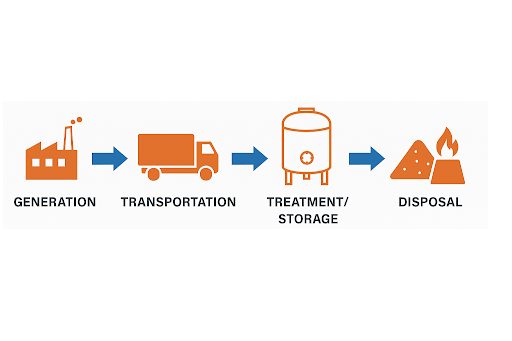
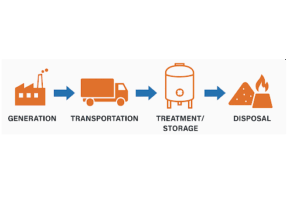
The Resource Conservation and Recovery Act (RCRA), signed into law in 1976, is the United States’ primary law regarding the disposal of solid waste and hazardous waste. This law was established to protect human and environmental health from waste disposal hazards by setting national goals for waste prevention, resource conservation, and “cradle-to-grave” management of hazardous waste.
RCRA applies to any person or company that generates, transports, treats, stores, or disposes of hazardous waste. RCRA tends to apply to industry or commercial waste rather than individual waste, where, instead of RCRA, recycling and proper disposal of hazardous wastes are encouraged.
What is Hazardous Waste?:
A hazardous waste is any solid waste that displays inherently hazardous characteristics or is generated by a waste stream that is listed as hazardous. There are many chemicals, from household cleaners to toxic sludge, that may fit this description. A variety of processes may generate hazardous waste, ranging from industrial, commercial, and even household activities. RCRA regulates this waste from the point it’s created all the way through disposal, commonly known as “Cradle-to-Grave”. Waste often may fit more than one category depending on what chemicals it contains, how it was generated, or what industry the waste originated from.
At L&M Environmental Response, we’ve broken down these complex regulatory categories into the checklists in Criteria 1 through 3. If your waste fits any other below, you may have a regulated hazardous waste.
Criteria 1 – Regulated Solid Waste?
While determining if a waste is solid seems like the most obvious step, solid wastes under RCRA can take place in solid, liquid, or gaseous form. Solid wastes are discarded material resulting from industrial, commercial, mining, and agricultural operations, as well as from community activities. In summary, if a waste is generated by industrial or commercial activity, it is most likely a regulated solid waste.
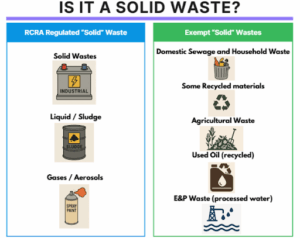
Criteria 2 – Is it Characteristic (D-List) Hazardous Waste?
Based on the inherent properties (characteristics) of a waste, the waste may be categorized as hazardous regardless of the composition or method of generation. This information can commonly be found in Section 2 of Safety Data Sheets (SDS) labelled “Hazard Identification”.
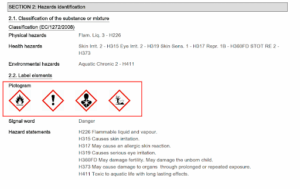
If you see one of the following graphics, you likely have a hazardous substance that will become a hazardous waste once used. Characteristic hazardous wastes are wastes that present one or more of the following four dangerous properties:

Criteria 3 – Is it a Listed Hazardous Waste?
Some wastes may be considered hazardous based on their source or composition (regardless of characteristics). Listed wastes are wastes from particular industrial processes or materials that the EPA classifies as hazardous. The EPA created the F-List and the K-List to organize waste based on the source, and the U-List and the P-List to organize waste based on its composition.
Criteria 3.a Process and Industry Specific Hazardous Wastes
If your company produces certain types of wastes from specific processes (F-List), they may be hazardous:
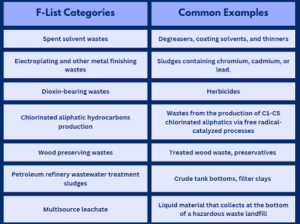
More Information about the F-List can be found here: 40 CFR section 261.31
If your company is one of the following sectors (K-List), certain waste streams are considered hazardous:
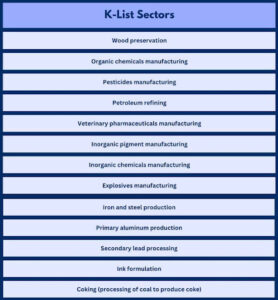
More information about the K-List can be found here: 40 CFR section 261.32
Criteria 3.b Chemical Specific Hazardous Wastes
Some chemicals are individually listed as hazardous when they are present in their pure form or as the sole active ingredient. These are listed on what’s called the P-List and U-List, and the rules apply specifically to the chemicals in their pure, unused form. Once the chemicals are used, they no longer fall under these lists. However, there’s an important detail: the empty containers that held P-List or U-List chemicals—and even the rinse water used to clean those containers—are still regulated as hazardous waste under these same lists.
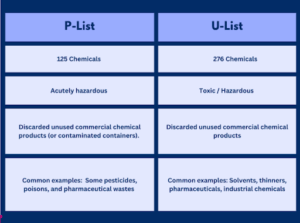
More information about the P-List and the U-List can be found here: 40 CFR section 261.33
If you answered yes to any of the above, you may have a regulated hazardous waste!
Correctly identifying and characterizing those wastes is the first step toward staying compliant and avoiding costly enforcement actions. L&M Environmental Response can help you determine which waste categories apply, and ensure your waste streams are properly managed and permitted. Our team understands how confusing these regulations can be, and we’re here to make the process streamlined and painless.